
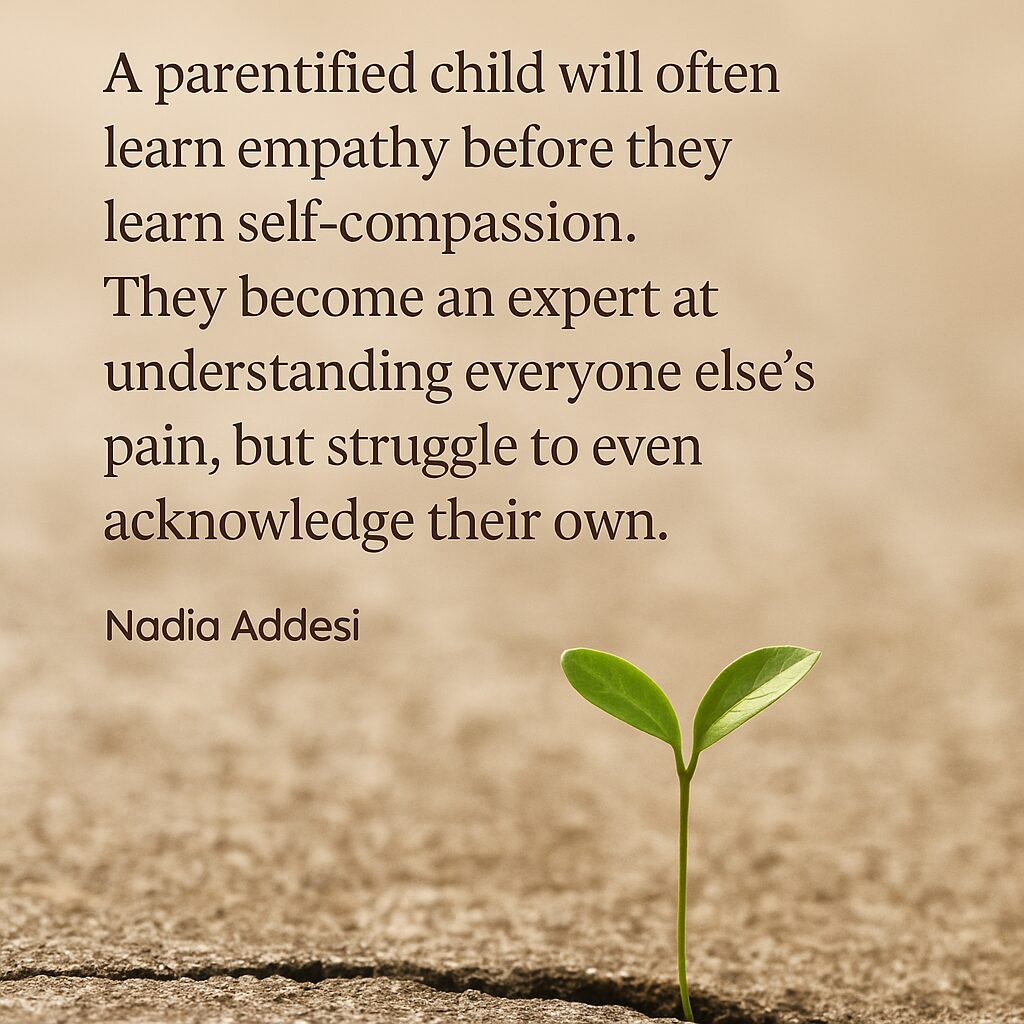
“A parentified child will often learn empathy before they learn self-compassion.
They become an expert at understanding everyone else’s pain, but struggle to even acknowledge their own.”
— Nadia Addesi
When a child is placed in the position of caring for a parent emotionally, they don’t just grow up faster — they grow around the needs of other people. Their attention shifts outward early, often before they’ve had the chance to develop a healthy relationship with their own feelings.
What Is a Parentified Child?
A parentified child is one who takes on adult responsibilities too soon — emotionally, practically, or both. This often happens in families affected by addiction, trauma, mental health struggles, or emotional neglect.
These children become the “responsible one,” the peacekeeper, or the listener. They learn to anticipate others’ moods and soothe emotional storms long before they understand their own emotions. From the outside, they appear mature, strong, and capable, but inside, they may feel unseen, anxious, or burdened.
The Cost of Growing Up Too Soon
When a child’s focus is always on others, their own emotions can feel unfamiliar or even unimportant. They learn to recognise and respond to other people’s pain but struggle to identify or soothe their own.
As adults, this might look like:
-
Compassion for everyone except yourself
-
Difficulty asking for help or expressing needs
-
Feeling guilty for resting or saying no
-
Confusing people-pleasing with kindness
-
Feeling emotionally exhausted, but unable to stop caring for others
That outward focus can feel like a strength — and in many ways, it is. Parentified children grow into adults who are empathic, intuitive, and caring. They notice what others need without being told.
But what often goes unnoticed is how hard it becomes to extend that same care inward.
How Healing Begins
Healing from parentification starts with slowing down and noticing the automatic patterns you learned to survive. It’s not about forcing self-compassion — it’s about creating the conditions where it can grow naturally.
That might mean:
-
Learning to name what you feel without minimising it
-
Pausing instead of pushing through when you’re overwhelmed
-
Letting others support you, even when it feels uncomfortable
-
Remembering that your needs and feelings are valid and important
With time and support, the same empathy that once went only toward others can begin to include you. Not because you’ve earned it or proven anything — but because you finally believe that your experience matters, too.
Therapy for the Parentified Child
If you grew up feeling responsible for everyone else, you might find it difficult to relax, trust others, or feel worthy of care. Working with a trauma-informed therapist can help you understand these patterns and begin to heal from the emotional burden you carried as a child.
In therapy, you can learn to:
-
Reconnect with your own emotions
-
Set boundaries without guilt
-
Untangle self-worth from caretaking
-
Develop genuine self-compassion
-
Heal the inner child who had to grow up too soon
Healing in Romford, Harold Wood, and the Havering Area
I offer trauma and addiction therapy in Romford and across Havering, helping adults explore the lasting effects of childhood experiences like parentification, codependency, and emotional neglect.
You don’t have to keep carrying the weight of everyone else’s pain. Healing is possible — and it begins with you.
You deserve the same compassion you give so freely.
Take the next step toward healing — reach out today to begin your journey back to yourself.
Contact me to arrange a free initial chat
Andrea, x